Tuesday, October 8, 2013

Is Anxiety Just the Norm?

"Anxiety disorders affect about 40 million American adults age 18 years and older (about 18%) in a given year, causing them to be filled with fearfulness and uncertainty" (National Institute of Health). Anxiety disorders are the most diagnosed mental conditions the the United States. There is no question that anxiety disorders are apart of many Americans' reality (mainly in Western America). However, how the condition is viewed medically and socially vary. These disorders have been claimed to be over-diagnosed (which may be true), over-dramatized, and a normal part of life.

Anxiety is a normal part of life. It is normal to have some anxiety in certain situation. It creates motivation and can improve focus. This type of anxiety is NOT the same as an anxiety disorder. When "normal anxiety" becomes an everyday occurrence, limiting normal functioning, this is when the label changes. Mental disorders are, and need to be treated like any other type of illness. Even though it cannot be seen by the naked eye does not mean that it isn't just as real. 

"Scientists currently think that, like heart disease and type 1 diabetes, mental illnesses are complex and probably result from a combination of genetic, environmental, psychological, and developmental factors" (NIH). This includes generalized anxiety disorder (GAD), obsessive-compulsive disorder (OCD), panic disorder, post-traumatic stress disorder (PTSD), and social phobia (or social anxiety disorder). The medication taken for all of these disorders do not cure, but they all alter brain chemistry while being taken. There is a chemical imbalance that needs to be fixed for the individuals that suffer. Medication and psychotherapy go hand-in-hand in the treatment process. Psychotherapy helps the sufferer change their thinking patters and reactions to anxiety provoking stimuli.

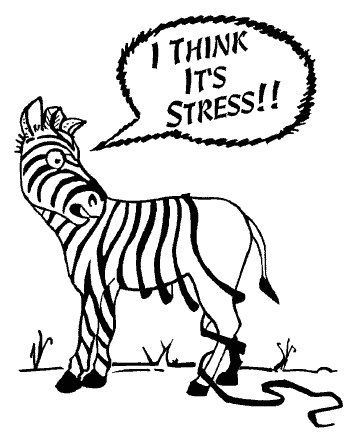
Anxiety disorders are completely separate from the nervous feeling before a test. It is a serious condition that requires medical treatment (just like any physical condition). As a society, we need to be educated on the fact that this condition a person can "snap out of".

Wednesday, September 25, 2013

Lets Get Personal

Anxiety is something that all of us encounter sometime in our life. Whether it is cramming for a test, applying to colleges, or worrying about what the cute guy thinks about you anxiety is everywhere. Anxiety can be productive and counterproductive at times, but what happens when someone has constant severe anxiety? Can this be treated with merely relaxation techniques and healthy communication?

 I have struggled with anxiety since high school. I was always worried about something. My anxiety would trigger migraines; at least once a month I would get one. Before tests, after tests, at swim meets, in practice, before bed, in the morning, anxiety was my closest enemy. I knew that my constant worrying was an issue, but I thought it was something I could easily fix on my own, so I didn't tell anyone about the problem. It wasn't until my sophomore year in college that I decided to see a doctor. I was put on a mild dose anxiety medication paired with talking with a health coach. This changed my world. I know that it is not the medication alone, but also the healthy communication paired along side it.

Wednesday, September 11, 2013

Current Event: The Mess of Stress


We all are living in a “life in the fast lane” society. Due to our type of lifestyle, the number of our population is beginning to deal with higher amounts of stress. According to the American Psychological Association, anxiety in America has been on the rise since 2007. The question we should be asking ourselves is what are the domino effects? Is anxiety really a bad thing, or merely a package deal in the search for excellence? Lastly, what are the physical implications? http://healthland.time.com/2013/02/07/the-most-stressed-out-generation-young-adults/
There are many types of stress, and each type has a different consequence. I was surprised to learn that persistent stress can actually lead to shrinking of the brain, depending on the type of stress. This unbroken anxiety targets different portions (mainly parts of the brain that deal with metabolism and emotion). According to Dr. Rajita Sinha (a professor of psychiatry and neurobiology at Yale University School of Medicine and director of the Yale Stress Center), single traumatic events are not considered to be the most detrimental to physical/mental health, but rather, the consistency of anxiety over a long period of time. She states, “The key take home message is that across the board the area that is most vulnerable to stress of any kind is the prefrontal cortex. It’s important for top-down regulation of our emotions, cognition, desires, and impulse control.” The prefrontal cortex (grey matter) is a precious part of the brain that needs to be protected. When that portion of the brain is massacred with stress, it becomes more difficult to resist addictive behaviors (drugs, alcohol, etc.). It also is more challenging to adapt to unexpected changes (adding to the anxiety continuum). http://healthland.time.com/2012/01/09/study-stress-shrinks-the-brain-and-lowers-our-ability-to-cope-with-adversity/
Currently, our generation is experiencing an overwhelming amount of new stressors due to new technologies, higher expectations, pressure of acceptance in a new age, and the fast tracked society that surrounds us. Anxiety has a negative connotation, but it does serve as a natural motivator. As stated by T.S. Elliot, anxiety is “the handmaiden of creativity."  Stress, in small doses, can be very beneficial. It is known to increase testosterone levels during a “fight or flight” experience. For example, this would enhance an athlete’s performance at an important meet/game/match when feeling anxiety.
Although anxiety can be beneficial in small doses, those whom feel anxiety on a daily basis are living an unhealthy mental/emotional lifestyle. One of the most effective ways to reduce stress is by merely improving communication skills. Learning how to say “no” goes a long way. Creating barriers is something that will improve quality of life in many aspects even beyond anxiety. It gives a person freedom to live for them. Since chronic anxiety has the ability to actually change the brain for the worse, it is important to take every step to a healthier you. 
For more information on the affects of anxiety and other helpful tips to combat anxiety watch this quick youtube clip from "Big Think" series. It's great!
http://www.youtube.com/watch?v=jRbGjWwNY-k

Wednesday, September 4, 2013

Introduction

Hello! My name is Haley Richter. I am a senior at Ball State majoring in health and physical education. I have had the fortune of being on the women's swim and dive team and it has been great experience. I am from a small town in Indiana, and plan on doing my student teaching over seas. After graduating I'm hoping to land a job teaching health, begin a graduate degree in psychology, and become a school counselor.

I am creating this blog to explore different ways to effectively incorporate technology in my future classroom. I have chosen to concentrate my blogs on Mental and Emotional health. I will focus in on the overlay between interpersonal communication (NHES 4) and preventing and managing emotional stress and anxiety in healthy ways (HBO 4).